Identification
What am I looking at?
Six things people bring us, and the one or two features that actually separate them. Three of the six should be left completely alone.
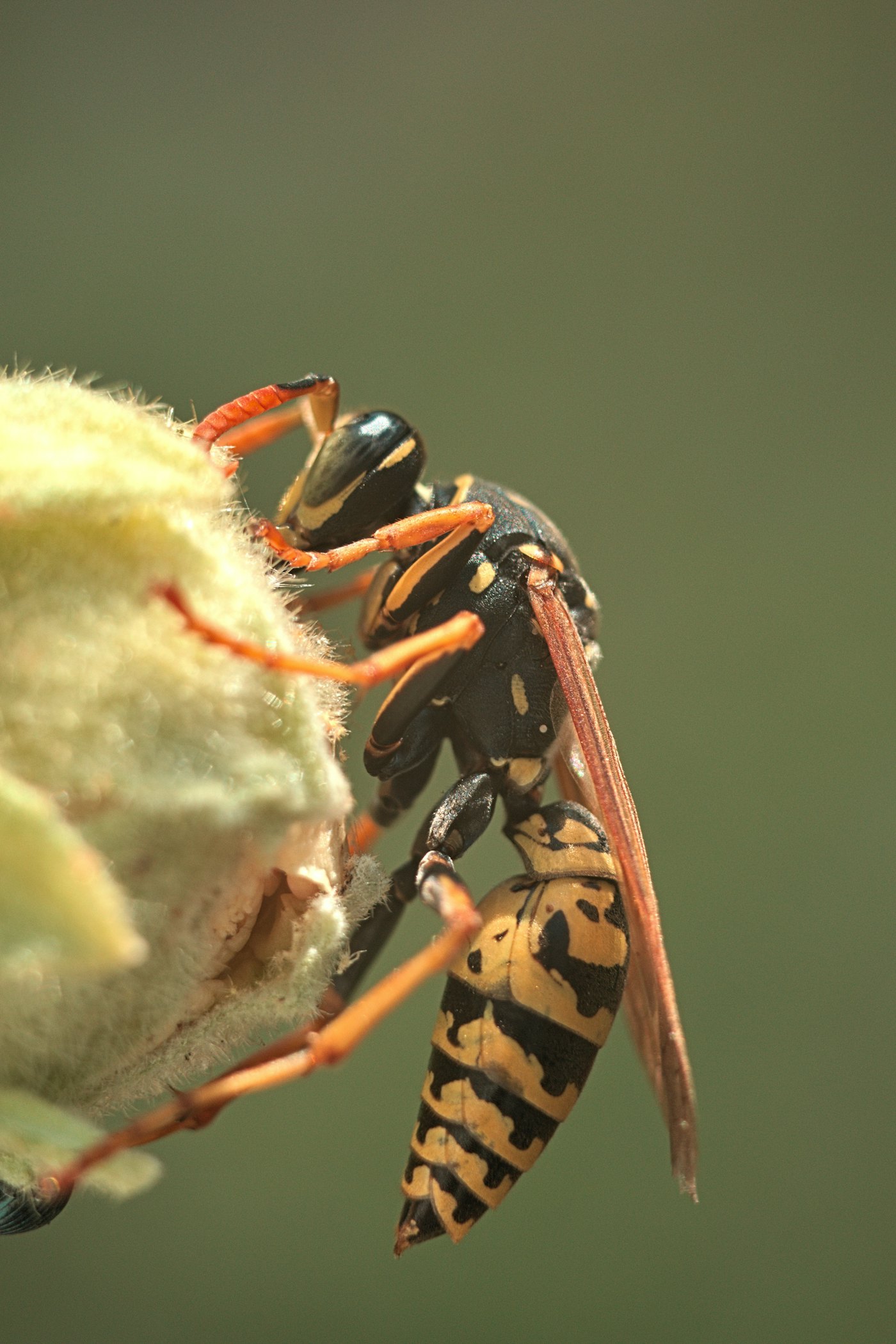
Yellowjacket
Vespula spp.
- Bright, hard-edged yellow and black bands
- Hairless and glossy
- Legs tucked in flight
- Nest papery, often underground or in a cavity
A trap is appropriate. Nests in walls or above head height are a professional job.
Paper Wasp
Polistes spp.
- Longer, narrower body than a yellowjacket
- Legs dangle visibly in flight
- Open honeycomb nest with no outer shell
- Much less aggressive than a yellowjacket
Often best left alone if the nest is away from doors and walkways.
Bald-Faced Hornet
Dolichovespula maculata
- Black with an ivory-white face and markings
- Large — up to 20mm
- Grey football-shaped aerial nest
- Defends a wide radius
Do not approach. This is a professional removal, every time.
Honeybee
Apis mellifera
- Golden-brown, fuzzy, softer outline
- Amber not bright yellow
- Carries pollen on hind legs
- Dies after stinging once
Never treat. A swarm is free-collected by local beekeepers; a wall colony needs a removal specialist.
Bumblebee
Bombus spp.
- Round, very furry, audibly heavy flight
- Broad bands, often with a white or orange tail
- Small colony, usually under 400
- Rarely stings unless handled
Leave alone. The colony dies back naturally by autumn and will not return to the same site.
Hoverfly
Syrphidae
- Hovers dead still, then darts sideways
- Two wings, not four
- Large fly-like eyes meeting at the top
- No sting at all
Harmless mimic. No sting, no nest, and a useful pollinator. Nothing to do.
Swarm or colony?
This distinction decides everything, and it is simpler than people fear.
A swarm is a loose cluster of bees hanging in the open — on a branch, a fence post, a wheelie bin. It arrived in the last day or two, it has no comb, no honey and no brood, and so it has essentially nothing to defend. It is usually remarkably calm. Left alone it will almost always move on within 48 hours, and a local beekeeper will often collect it for free before then.
A colony is established inside a cavity — a wall, a chimney, a roof void, a hollow tree. You will see steady two-way traffic at one small entrance rather than a visible cluster. This is a structural job: the comb has to come out or it will ferment and attract pests, and that needs a removal specialist rather than a general pest controller.
Why this matters commercially
We would rather lose a trap sale than sell you one for a bumblebee nest that was going to die back on its own in September. There is no version of this business that works if the equipment gets used on the wrong insect.
Send us a photo
We answer identification questions whether or not you buy anything. Photograph from a safe distance — a phone at 2m with digital zoom is better than a clear shot from 30cm.
Ask about an insectThen what?
If it is a wasp and the nest is small, low and away from anyone with an allergy, the equipment below covers it. If any of those three things is not true, read the safety page first.